
|
|
|||||||||||||||||
|
|
|
|||||||||||||||||
Building Collaborative Intelligence: The Translational Journey of the Smart Amplified Group Environment Across Research, Education, and Practice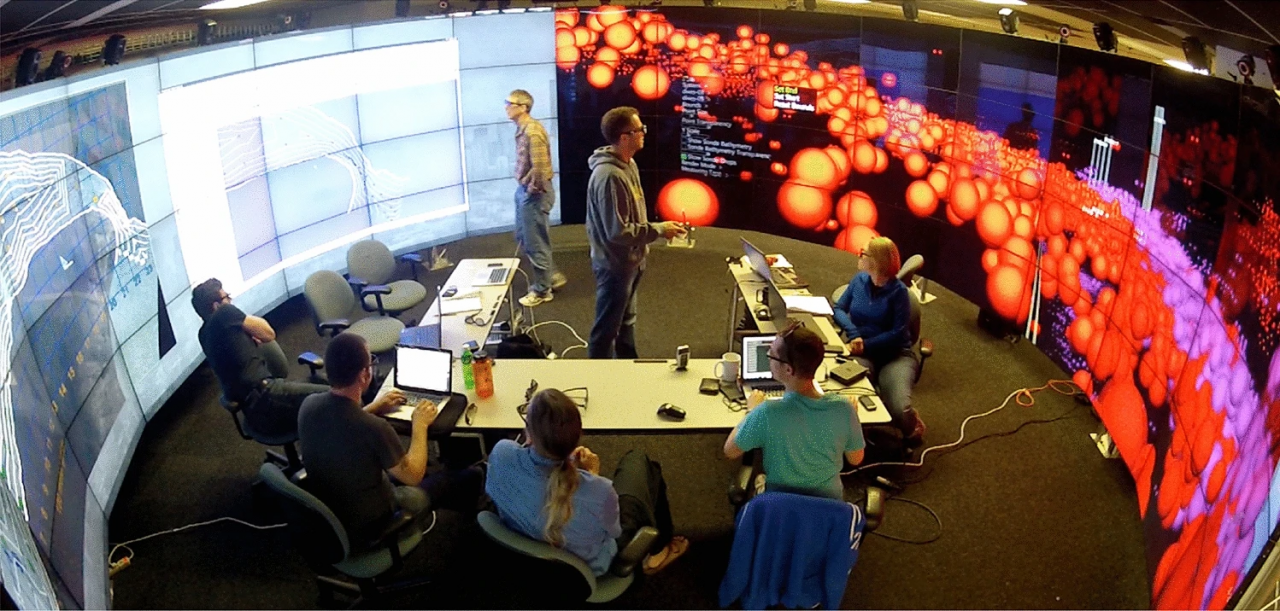
Authors: Leigh, J., Renambot, L., Theriot, R., Long, L., Lee, C., Harden, J., Kirshenbaum, N., Belcaid, M., North, C., Johnson, A., Brown, M.
Publication: Springer Nature Computer Science, vol 7, no 281, Springer URL: https://link.springer.com/article/10.1007/s42979-026-04861-5 The SAGE Suite - SAGE1, SAGE2, and SAGE3 - translates advances in visualization, cyberinfrastructure, and human-computer interaction into an open, scalable platform that aligns with embodied cognition to support collaborative, spatial reasoning on large displays and personal devices. Over two decades and hundreds of deployed walls worldwide, SAGE has enabled scientists, educators, and students to juxtapose heterogeneous media, sustain shared context, and accelerate sensemaking across the research lifecycle. This paper contributes: (1) a synthesis of the Suite’s translational impact across domains - from biology and atmospheric science to disaster management, health care, public outreach and workforce development; (2) a comparative framing of SAGE3 (the Smart Amplified Group Environment) among Computer Supported Cooperative Work and infinite-canvas tools; (3) the design rationale and user experience foundations of SAGE3’s “spatial thinking operating system,” including boards, rooms, wall viewports, and multi-user attention/flow mechanisms; (4) a modular architecture that delivers low-latency synchronization, extensibility via plugins, and privacy-aware deployment; and (5) a paradigm for human - Artificial Intelligence (AI) collaboration that spatializes notebooks and conversational workflows, enabling multi-user, multi-AI interaction grounded in shared visual context. We also surface systemic challenges in recognizing software-as-instrument within academic incentives and document emergent usage patterns spanning synchronous/asynchronous, co-located/distributed work. SAGE3 demonstrates how open, research-driven cyberinfrastructure can couple spatial cognition with collective intelligence to advance scientific collaboration and decision-making. Keywords: Cyberinfrastructure - Collaboration - Computer supported cooperative work - Artificial intelligence - Human computer interaction - Embodied cognition Date: March 17, 2026 Document: View PDF |